2026.09.23
What is "true closeness" in oil massage?
query_builder
2026/09/03
swedishswedish
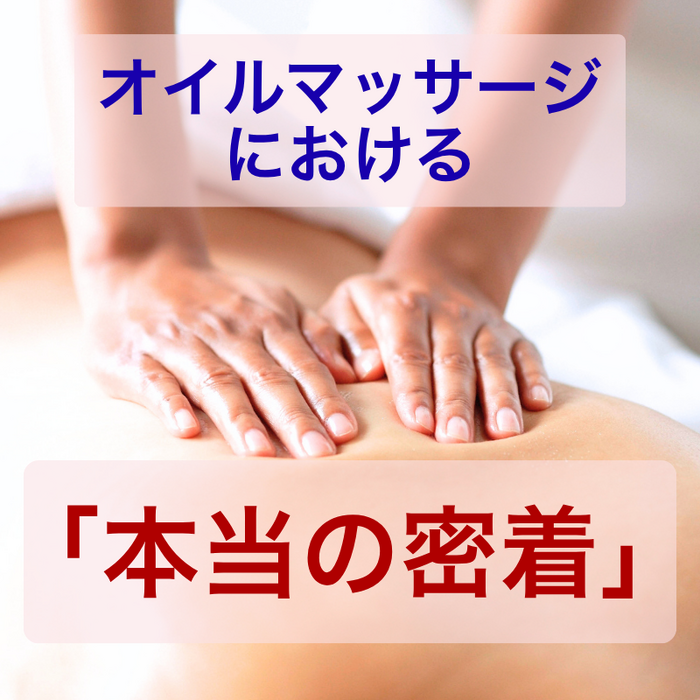
What is "true closeness" in oil massage?
When someone tells you to "get closer," do you find yourself tensing your hands or consciously trying to "get closer"?
The term "close contact" is often used in oil massage, but many therapists misunderstand that close contact is not something that can be achieved with the hands alone.
No matter how hard you press your palm against it, or how hard you try to make it touch, true contact will never occur.
On the contrary, the more force you apply, the more superficial the treatment becomes, merely stroking the surface of the skin.
In my opinion, true closeness requires the following three elements:
• How to use your body weight (weight transfer from the core)
- Posture (the therapist's own positioning) and direction and position of pressure
- Controlling the amount of oil
And although it's often overlooked, the final "amount of oil" is the key to determining the quality of the adhesion.
Why does the amount of oil affect "adhesion"?
If there's too much oil, your palms will simply slide over your skin.
As a result, no matter how much weight you try to apply, the pressure escapes, and the treatment ends up being merely a "surface stroking."
In Swedish massage, the amount of oil used is very small.
Use only the minimum amount necessary to avoid skin irritation and pain.
Think of the oil not as something to "make things slide," but rather as a kind of "glue" that fills the gaps between the therapist's palms and the client's skin .
The moment you switch to this way of thinking, your hands and skin become one, like a single membrane, and a close bond is created.
This is a common misconception – the true relationship between oil volume and friction.
"Less oil = more friction."
"More oil = better adhesion"
Actually, neither is entirely accurate.
Whether friction occurs and whether contact is created depends on the combination of the "amount of oil" and the "way you apply your weight."
Let's organize this:
● Too much oil × Hands that aren't putting weight on them
My hands slip across my skin
Friction is less likely, but there is no weight applied and therefore no pressure.
Customers feel "it feels good but unsatisfying" or "it feels somewhat shallow" → This is not a friction issue, but rather a "missed opportunity for pressure."
● Insufficient oil × Hands not putting enough weight on the ball (A common mistake when using too little oil)
My hand caught on the skin, and the skin was pulled.
This is transmitted to the brain as a frictional stimulus (shuffling or pulling).
When the receptors in the epidermis perceive it as a "shallow and fast stimulus," the sympathetic nervous system becomes dominant, making the customer more likely to feel "pain" or "being rubbed."
The therapist's hands and fingers also bear a heavy burden.
● Less oil × Hands with firm pressure (close contact in Swedish massage)
The palm and skin become one like a single membrane; the skin doesn't "pull" but moves together with the fascia, so you don't feel any friction.
The pressure is applied over a surface and reaches deep into the fascia and muscle belly as shear force.
Even with the same "less oil" method, what happens inside the skin is completely opposite depending on whether or not body weight is applied.
It's not as simple as just "reducing the amount of oil"; the oil only functions as an adhesive when combined with a posture that allows you to put your weight on it.
Hands in close contact vs. hands not in close contact
What is happening inside the body?
Even though it may appear as if you are "touching" someone, the quality of the contact can mean completely different things happening inside the body.
This is the biggest point that makes many students think, "So that's what it was!"
● If your hands are not touching
- The pressure stops at the skin surface or slips away.
- When using less oil and not applying body weight, the skin can be stretched and irritated by friction.
- When there is too much oil and no body weight is applied, the pressure is wasted and nothing reaches the deep tissues. In both cases, the sympathetic nervous system tends to become dominant, and muscle tension may actually remain.
Because the water (matrix) of the fascia cannot be accessed, the gliding ability does not improve.
Therapists also experience concentrated strain on their fingers and wrists, leading to fatigue.
● When hands are in close contact (minimum oil × body weight applied)
- The pressure "passes through" the skin and reaches deep into the fascial layer and muscle belly.
Because the entire palm is integrated with the skin, the shearing force is gradually transmitted to the tissue.
Receptors that detect slow changes, such as the end of the Rufini cycle, become active, and the parasympathetic nervous system becomes dominant.
When the parasympathetic nervous system is activated, blood vessels dilate, improving blood and lymphatic flow. Excessive firing of muscle spindles is suppressed, and muscle tension is relaxed.
- The brain recognizes relaxation, and the function of internal organs becomes more regulated.
- The hyaluronic acid (matrix) within the fascia warms up and becomes fluid, allowing the previously adhered layers to regain their ability to glide.
Customers feel that the massage "reaches deep into their bodies" and "feels so good that it makes them sleepy."
- The therapist uses weight from their core, so their hands don't get tired and they can maintain stability even during long treatment sessions.
Close contact is a technique for switching on a "physiological switch."
Hands don't just create a feeling of "pleasantness."
This technique switches the autonomic nervous system to the parasympathetic side through skin sensory receptors, thereby changing the condition of the fascia and muscles from within.
Hands that are not in close contact → Friction or pressure on the surface is ineffective → Sympathetic nervous system dominance → Treatment results in lingering tension
Close contact with the hands → deep surface pressure → parasympathetic nervous system dominance → truly relaxing treatment
Even with the same "oil massage," this difference can greatly affect the results.
Three conditions for creating true closeness
1. Create a position where you can "put your weight" into it (send pressure from your core, not your hands).
2. Align the direction of pressure with the direction of the muscle fibers and fascia (avoid applying force diagonally or in an escaping direction).
3. Use oil sparingly as an "adhesive" (not as a lubricant).
When these three elements are in place, your hands and the client's body become one, and true change begins beneath the skin.
What we teach in Swedish massage is precisely how therapists can visualize and touch the "phenomena happening inside."
Once this is communicated, the treatment will change dramatically.
KAORI
----------------------------------------------------------------------
Executive Academy Osaka
Address: 601 Excel Utsubo, 1-8-12 Kyomachibori, Nishi Ward, Osaka City, Osaka Prefecture
----------------------------------------------------------------------
therapist
therapist
oil
oil
aroma
aroma
body
body
lymph
lymph
NEW
-
-
2026.09.22Isn't it time to stop...Isn't it time to stop "gypsy" from one massage ...
-
2026.09.21What do we do to "rel...I want to help my clients relax their bodies. I...
-
2026.09.20I've learned skills a...The other day, someone came all the way from a ...
-
2026.09.14Back to relaxation.I've recently noticed a gradual shift happening...
-
2026.09.13Why do the "way you t...Why do the "way you touch" and the "words you u...
-
2026.09.08The same words, yet w...The same words, yet why do some people's words ...
-
2026.09.06What is "shearing" in...What is "shearing" in Swedish massage? Shearing...
VIEW MORE
CATEGORY
ARCHIVE
- 2026/0911
- 2026/0810
- 2026/076
- 2026/068
- 2026/0511
- 2026/048
- 2026/037
- 2026/028
- 2026/017
- 2025/123
- 2025/111
- 2025/105
- 2025/082
- 2025/072
- 2025/062
- 2025/031
- 2024/121
- 2024/1117
- 2024/1018
- 2024/0918
- 2024/0819
- 2024/0714
- 2024/068
- 2024/0511
- 2024/0410
- 2024/0310
- 2024/0220
- 2024/017
- 2023/121
- 2023/111
- 2023/106
- 2023/098
- 2023/089


