2026.09.23
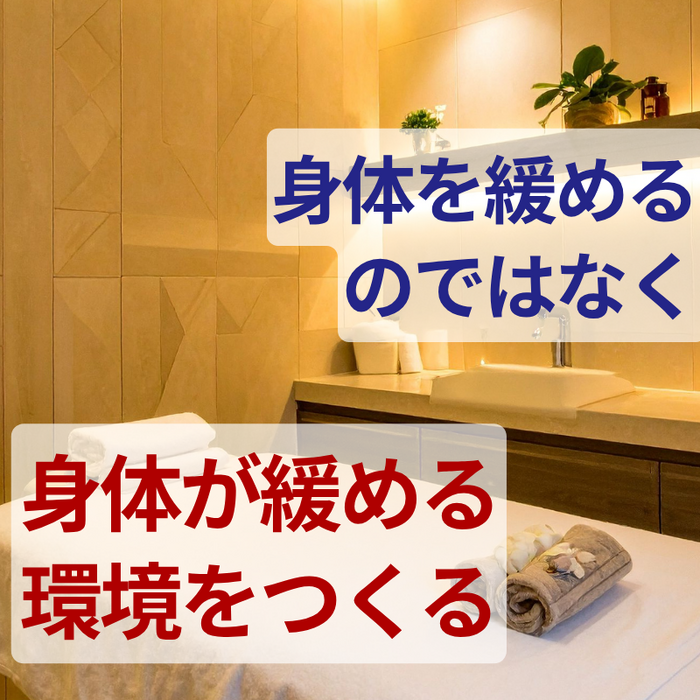
Instead of forcing your body to relax, create an environment where your body can relax on its own.
query_builder
2026/08/09
swedishswedish
A way of touching that makes the body feel "this place is safe"
In oil massage, the key to releasing tension deep within the body is not to apply strong pressure.
First, you need to make your body feel that "this is a safe place."
The body has a mechanism to receive external stimuli and protect itself.
That's why the more "sudden" a touch is, the more the body unconsciously tenses up.
Conversely,
It is predictable that it will be touched.
It's also possible to predict when you might lose touch with it.
The pressure changes are gradual.
warm.
And my hands won't leave my body.
If you continue to touch them in that way, their bodies will gradually lower their guard.
Touch with a "surface" rather than a "point".
The important thing is not to grasp the body with only a part of your hand.
Keep your entire palm in close contact with your body to maintain as uninterrupted contact as possible.
Suddenly, their hands let go.
Suddenly, another place is touched.
The pressure suddenly increases.
These unpredictable stimuli can cause the body to tense up unconsciously.
Therefore, we consider the entire process, from when our hands touch to when they separate, as a single continuous flow.
"What to do next"
"What is the body you are touching right now feeling?"
It's important to touch while being aware of that feeling.
Oil is not just for "making things slide."
Too much oil can cause your hands to slide too easily over the surface of your body, making it difficult to feel the sensation of being touched.
Use only the necessary amount to create a comfortable, even fit between your palm and skin.
This makes it easier for the body to perceive changes in the temperature, movement, and pressure of the practitioner's hands.
The "touch and closeness" that EAO values is not merely a technique.
It's about continuously telling your body, "I am here."
I believe that's the kind of touch that leads to a sense of security.
Instead of "applying" or "releasing" pressure, connect it.
The same applies to pressure.
Do not apply pressure suddenly.
Do not suddenly release the pressure.
The pressure gradually increases from zero, and then gradually decreases again.
By smoothly transitioning between these changes, the body becomes more receptive to stimuli.
The more the practitioner tries to "make it work," the more the recipient's body may unconsciously tense up as well.
That's why,
The key is not to make it stronger, but to keep it from breaking down.
Rather than deepening the understanding, the focus should be on being able to receive it with peace of mind.
I will cherish that.
The temperature of your hands is also part of how you touch someone.
If you are suddenly touched by a cold hand, your body may tense up reflexively.
Conversely, warm hands, warm oil, and a comfortable room temperature.
That alone creates an environment that is more accepting.
Furthermore, it is known that slow, gentle touch stimulates brain mechanisms related to comfort and security through the tactile system in the skin.
In other words, what is needed to relax the body is
It's not about "rubbing harder."
Creating conditions that allow the body to relax and release tension.
A therapist is not someone who forcibly relaxes the body.
A person who creates an environment where the body can relax on its own.
for that,
Hands touching.
A steady rhythm.
Smooth pressure.
temperature.
And the therapist's own calm demeanor.
Each and every one is important.
The body is most likely to perform at its best when it feels safe and secure.
Therefore, I believe that massage techniques should not be judged solely on "how much the body can be changed,"
"How much space can we create where the body feels safe and can change on its own?"
That's the perspective I'm considering.
And to reproduce all of these ways of touching, "technology" alone is actually not enough.
The close contact of the hands, the smoothness of the pressure, the consistent rhythm, and the way you touch while feeling the other person's body.
It all stems from how the therapist uses their own body.
If you're using force in an awkward posture, your hands won't be in close contact with your body.
If you're tensing your own body unnecessarily, it becomes difficult to sense even the slightest changes in the other person's body.
Therefore, when I teach Swedish massage, I teach not only the technique itself, but also
I spend the most time on "how to use my body to touch."
Before learning techniques, focus on getting your own body in shape.
Create your own core, use your body weight, and touch while breathing.
This allows you to touch your opponent using your entire body, rather than just your hands.
And then, for the first time,
A way of touch develops that allows the body to relax naturally, without even trying to "relax the body."
KAORI
----------------------------------------------------------------------
Executive Academy Osaka
Address: 601 Excel Utsubo, 1-8-12 Kyomachibori, Nishi Ward, Osaka City, Osaka Prefecture
----------------------------------------------------------------------
therapist
therapist
oil
oil
aroma
aroma
body
body
lymph
lymph
NEW
-
-
2026.09.22Isn't it time to stop...Isn't it time to stop "gypsy" from one massage ...
-
2026.09.21What do we do to "rel...I want to help my clients relax their bodies. I...
-
2026.09.20I've learned skills a...The other day, someone came all the way from a ...
-
2026.09.14Back to relaxation.I've recently noticed a gradual shift happening...
-
2026.09.13Why do the "way you t...Why do the "way you touch" and the "words you u...
-
2026.09.08The same words, yet w...The same words, yet why do some people's words ...
-
2026.09.06What is "shearing" in...What is "shearing" in Swedish massage? Shearing...
VIEW MORE
CATEGORY
ARCHIVE
- 2026/0911
- 2026/0810
- 2026/076
- 2026/068
- 2026/0511
- 2026/048
- 2026/037
- 2026/028
- 2026/017
- 2025/123
- 2025/111
- 2025/105
- 2025/082
- 2025/072
- 2025/062
- 2025/031
- 2024/121
- 2024/1117
- 2024/1018
- 2024/0918
- 2024/0819
- 2024/0714
- 2024/068
- 2024/0511
- 2024/0410
- 2024/0310
- 2024/0220
- 2024/017
- 2023/121
- 2023/111
- 2023/106
- 2023/098
- 2023/089


