2026.09.23
Why do I prioritize "how to touch" over muscles?
query_builder
2026/07/13
swedishswedish
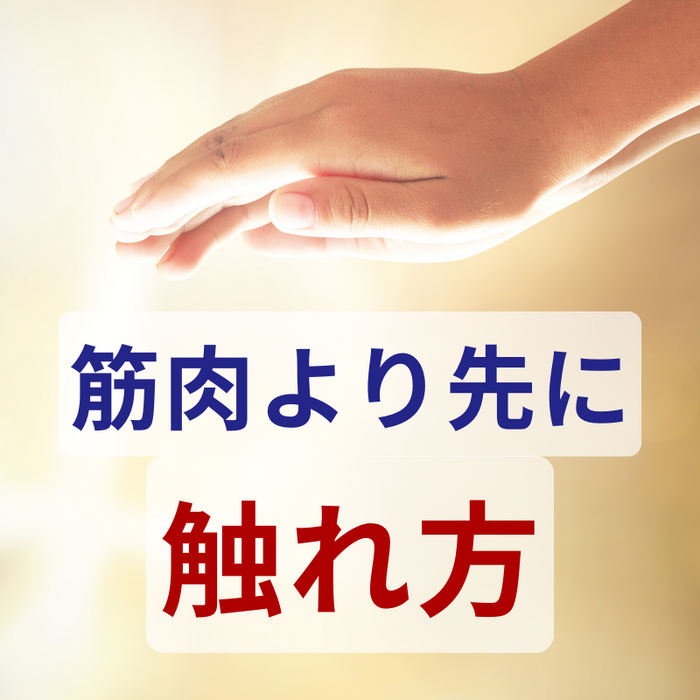
When people hear the phrase "skillful treatment," many might think of the type of technique used or the approach taken to the muscles.
Of course, those are important too.
However, I believe there are more important things to consider before even thinking about what techniques to use.
That's how you touch it.
This is because the body, from the moment it is touched, judges whether the stimulus is "safe" or "something to be wary of."
Therefore, before I approach the muscles, I prioritize creating a touch that the nervous system can accept with ease.
To understand the reason, we first need to know the role of the tissue called "skin."
Skin is not just a tissue that covers the body.
It is the body's largest organ, responsible for many physiological functions, including sensory reception, immunity, defense, and thermoregulation.
And what's important in treatment is that the skin is both the boundary with the outside world and a crucial entry point that transmits information about the body's internal state to the brain .
In recent years, neuroscience has focused on CT tactile fibers , which are abundant in hairy skin.
These nerve fibers are known to respond more readily to warmth close to skin temperature and stable contact, rather than to strong stimuli. It has also been reported that tactile stimulation at a constant speed is often associated with a feeling of comfort.
This input is thought to be related not only to the sensation of being "touched," but also to feelings of comfort, security, and the bodily sensation of feeling that one's own body is one's own.
In other words, from the moment we touch someone, their body unconsciously judges whether "this stimulus is safe or something to be wary of."
Therefore, what I focus on when introducing a treatment is not simply "touching slowly."
It's about touching the other person in a rhythm that allows their body to receive it with ease.
Speed itself isn't the important thing; it's about the body accepting it naturally without having to brace itself.
Therefore, I
- Touch with a wide contact surface
- Touching with pressure that comes from the coordinated movement of the entire body, rather than brute force.
- Touch in a rhythm that is easy for the other person's body to receive.
Avoid creating sudden changes in pressure.
- Touch with hands that are close to skin temperature.
- Be careful until the very last moment you let go.
We cherish these things.
This isn't simply about aiming for a "pleasant way to touch."
It's about creating a physiological environment that sends the message to the nervous system that "this stimulus is not a threat."
Of course, current research shows that the effects of tactile stimulation on the autonomic nervous system vary from person to person, and the effects are not uniform.
Therefore, I don't use expressions like "this touch changes the brain" or "this adjusts the internal organs."
However, many studies have shown that a sense of security and comfort arising from the skin can alleviate defensive reactions, making breathing, muscle tone, and bodily sensations more susceptible to change, and this is something I have consistently observed in my own 23 years of clinical practice.
If you want to change your muscles, you don't need to start by targeting the muscles themselves.
On the contrary, strong stimulation, rapid friction, and painful pressure can trigger a defensive reaction in the body, which can ultimately increase muscle tension.
That's why I first focus on perfecting the "way of touching."
When the way you touch something changes, the way your skin perceives it changes.
When the way the skin perceives something changes, the nervous system's response changes as well.
As a result, your breathing changes, your muscles change, and even your posture and how you use your body changes.
I believe this sequence is the most natural and least stressful way for the body to change.
The way you touch someone is not just a technique.
This is a form of physiological communication designed to convey a sense of "reassurance" to the other person's nervous system.
That's why EAO prioritizes "how to touch" before focusing on the muscles themselves.
KAORI
----------------------------------------------------------------------
Executive Academy Osaka
Address: 601 Excel Utsubo, 1-8-12 Kyomachibori, Nishi Ward, Osaka City, Osaka Prefecture
----------------------------------------------------------------------
therapist
therapist
oil
oil
body
body
NEW
-
-
2026.09.22Isn't it time to stop...Isn't it time to stop "gypsy" from one massage ...
-
2026.09.21What do we do to "rel...I want to help my clients relax their bodies. I...
-
2026.09.20I've learned skills a...The other day, someone came all the way from a ...
-
2026.09.14Back to relaxation.I've recently noticed a gradual shift happening...
-
2026.09.13Why do the "way you t...Why do the "way you touch" and the "words you u...
-
2026.09.08The same words, yet w...The same words, yet why do some people's words ...
-
2026.09.06What is "shearing" in...What is "shearing" in Swedish massage? Shearing...
VIEW MORE
CATEGORY
ARCHIVE
- 2026/0911
- 2026/0810
- 2026/076
- 2026/068
- 2026/0511
- 2026/048
- 2026/037
- 2026/028
- 2026/017
- 2025/123
- 2025/111
- 2025/105
- 2025/082
- 2025/072
- 2025/062
- 2025/031
- 2024/121
- 2024/1117
- 2024/1018
- 2024/0918
- 2024/0819
- 2024/0714
- 2024/068
- 2024/0511
- 2024/0410
- 2024/0310
- 2024/0220
- 2024/017
- 2023/121
- 2023/111
- 2023/106
- 2023/098
- 2023/089


