2026.09.23
The science of "pleasure"
query_builder
2025/10/17
swedishswedish
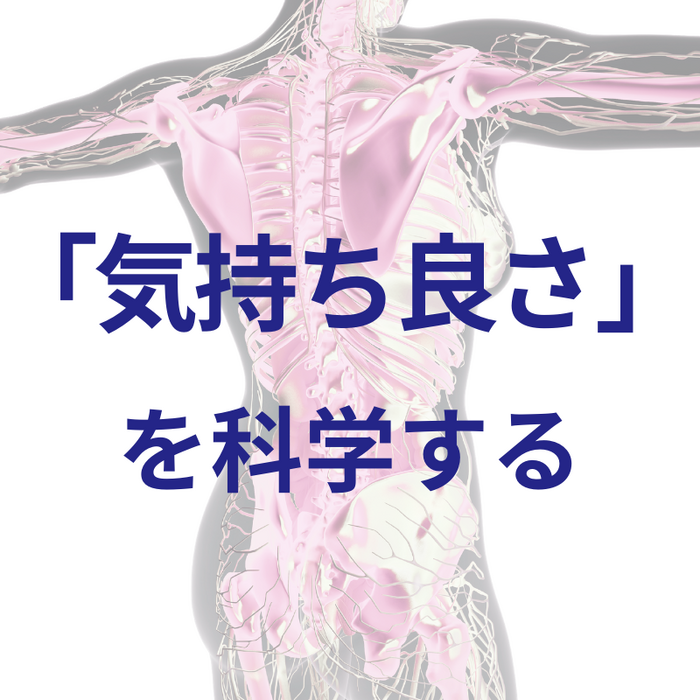
In the relaxation industry
It's often assumed that "pleasure equals sensation."
Often used in school and salon introductions
You often see taglines that say, "Technology that's more than just pleasurable,"
The feeling of "comfort" can be explained by science, and you don't need to frantically try to loosen your muscles. Simply using techniques that make you feel good will loosen them up and even activate the body's natural healing power, returning it to its original state.
① The mechanism of "pleasure"
There are laws governing the bodily responses that lead to moments of feeling "good."
Skin and nerve response: Slow, constant pressure or friction → Tactile fibers react → This is transmitted to a part of the brain called the "insular cortex" → We feel "safe," "trust," and "happiness."
• At this time, oxytocin, serotonin, and the parasympathetic nervous system are activated.
In other words,
"Pleasantness" is a state in which the nerves perceive safety.
It's not force, but rather temperature, rhythm, and speed that have a precise influence.
② The science of "temperature and flow"
The Swedish method of "small amount of oil × skin friction" actually generates far-infrared rays and frictional heat.
• Far-infrared rays → dilate capillaries → promote blood flow, lymphatic drainage, and ATP metabolism • Frictional heat → warms nerve endings, leading to parasympathetic nervous system dominance • Increased body temperature changes the viscoelasticity of fascia → naturally relaxes even deep tissues
In other words,
"Feeling good" is the resonance of heat and circulation.
It feels like the flow of energy in my body is being restored.
③ The science of “being”
And that's the part EAO values most.
• The therapist's breathing, rhythm, and state of consciousness are reflected in the temperature of their hands, the smoothness of their movements, and the waveform of their pressure.
• This is transmitted through the skin to the opponent's nerves through resonance.
• In other words, the therapist's awareness of "being present in the moment" is transmitted to the recipient's body as a sense of "reassurance."
Here,
There is a new kind of "science of comfort" that views "how to regulate one's consciousness" as "an aspect of technique."
The science of feeling good,
This field of study explores, from both anatomical and sensory perspectives, the mechanisms by which temperature, rhythm, nerves, and consciousness resonate with "safety and security."
And EAO's Swedish language program is precisely a "school that teaches through experience."
KAORI
----------------------------------------------------------------------
Executive Academy Osaka
Address: 601 Excel Utsubo, 1-8-12 Kyomachibori, Nishi Ward, Osaka City, Osaka Prefecture
----------------------------------------------------------------------
body
body
NEW
-
-
2026.09.22Isn't it time to stop...Isn't it time to stop "gypsy" from one massage ...
-
2026.09.21What do we do to "rel...I want to help my clients relax their bodies. I...
-
2026.09.20I've learned skills a...The other day, someone came all the way from a ...
-
2026.09.14Back to relaxation.I've recently noticed a gradual shift happening...
-
2026.09.13Why do the "way you t...Why do the "way you touch" and the "words you u...
-
2026.09.08The same words, yet w...The same words, yet why do some people's words ...
-
2026.09.06What is "shearing" in...What is "shearing" in Swedish massage? Shearing...
VIEW MORE
CATEGORY
ARCHIVE
- 2026/0911
- 2026/0810
- 2026/076
- 2026/068
- 2026/0511
- 2026/048
- 2026/037
- 2026/028
- 2026/017
- 2025/123
- 2025/111
- 2025/105
- 2025/082
- 2025/072
- 2025/062
- 2025/031
- 2024/121
- 2024/1117
- 2024/1018
- 2024/0918
- 2024/0819
- 2024/0714
- 2024/068
- 2024/0511
- 2024/0410
- 2024/0310
- 2024/0220
- 2024/017
- 2023/121
- 2023/111
- 2023/106
- 2023/098
- 2023/089


